China has become an important sourcing market for electric vehicles, plug-in hybrid vehicles, range-extended vehicles, fuel vehicles and commercial fleets.
However, importing cars from China is not simply a matter of selecting a model and comparing prices.
A professional vehicle import project must align the exact vehicle configuration, destination-market requirements, supplier evidence, commercial terms, export documentation, inspection standards, shipping arrangements and after-sales responsibilities.
This guide explains the main steps overseas dealers, distributors, fleet operators and automotive trading companies should complete before importing vehicles from China.
PortAuto provides project-specific vehicle sourcing, configuration verification, export documentation coordination, inspection support and international logistics for professional buyers. Availability and commercial terms are confirmed through a current quotation rather than treated as permanent online inventory.
2026 Regulatory Update for Electric Vehicle Exports
From January 1, 2026, China introduced export licence management for pure electric passenger vehicles under the referenced customs classification.
This means buyers should not evaluate an exporter only by the price shown in a quotation. They should also confirm whether the exporting company can legally coordinate the applicable vehicle export licence, customs declaration and supporting documentation for the intended shipment.
Requirements may differ between pure electric, plug-in hybrid, fuel and used vehicles. The exact export procedure must therefore be checked according to the model, condition, customs classification and current regulations.
Who Is This Guide For?
This guide is intended for:
- Overseas vehicle importers
- National and regional distributors
- Dealership groups
- Independent automotive dealers
- Fleet and rental companies
- Taxi and ride-hailing operators
- Government and corporate project buyers
- Automotive trading companies
Individual buyers may use the guide as a reference, but PortAuto primarily focuses on professional B2B vehicle sourcing and export projects.
Step 1: Define the Complete Vehicle Requirement
A model name alone is not enough for an accurate quotation.
Before contacting a Chinese vehicle supplier, prepare a structured sourcing requirement containing the following information.
| Requirement | Information to Provide |
|---|---|
| Buyer type | Importer, distributor, dealer, fleet operator or trading company |
| Destination | Country, region and destination port |
| Vehicle condition | Factory-new, unregistered, registered used or open to discussion |
| Brand and model | Exact brand and vehicle name |
| Model year | Required production or model year |
| Configuration | Trim, battery, engine, drivetrain, seating and options |
| Steering position | Left-hand drive or right-hand drive |
| Quantity | Sample quantity and expected future volume |
| Exterior and interior | Required colours and acceptable alternatives |
| Powertrain | BEV, PHEV, EREV, HEV or gasoline |
| Software | English, Russian or another required language |
| Charging requirement | Plug standard, voltage, frequency and adapter needs |
| Trade term | FOB or CIF |
| Delivery timing | Required shipping or arrival period |
| Documentation | Destination-specific certificates or supporting records |
A complete sourcing brief helps the exporter check the correct vehicle instead of quoting a similar-looking but unsuitable configuration.
Step 2: Check the Destination Market Before Confirming the Vehicle
The lowest-priced vehicle is not always the most suitable vehicle for a particular country.
Before making a deposit, the buyer should confirm local requirements related to:
- Vehicle homologation
- Registration eligibility
- Import age restrictions
- Left-hand-drive or right-hand-drive rules
- Emission requirements
- Lighting standards
- Safety certification
- Charging-port standards
- Radio and communication equipment
- Customs classification
- Import duties and taxes
- Battery or recycling requirements
- Required certificates and translations
These requirements normally belong to the destination market and should be confirmed by the buyer, local customs broker, homologation consultant or relevant authority.
PortAuto can coordinate available export-side evidence and documents within the agreed project scope, but destination-country approval cannot be assumed from a vehicle photo, model name or China-market specification.
Step 3: Verify the Chinese Vehicle Exporter
A professional quotation should identify the company that will actually sign the contract, receive payment and export the vehicles.
Before proceeding, check:
- The exporter’s full legal company name.
- Whether the company information matches the contract and payment account.
- Whether the exporter can handle the required vehicle category.
- Whether the quotation clearly identifies the model, trim and condition.
- Whether vehicle and supplier evidence can be provided.
- Which company is responsible for documentation and customs coordination.
- Which services are included or excluded from the price.
- How inspection, loading and shipping evidence will be provided.
- Whether after-sales and spare-parts responsibilities are clearly stated.
- How commercial disputes or configuration differences will be handled.
A low quotation without a clear vehicle scope, export entity or responsibility boundary can create more risk than a slightly higher but properly documented offer.
Step 4: Confirm the Exact Vehicle Condition
One of the most important questions is whether the vehicle is being supplied as:
- Factory-new and never registered
- New but previously registered in China
- A zero-mileage used vehicle
- A conventional used vehicle
- A demonstration or display vehicle
- A modified export vehicle
These categories may have different documents, pricing, tax treatment and destination-market implications.
When a buyer requires a factory-new and never-registered vehicle, that condition should be written clearly in the sourcing requirement, quotation and contract.
The buyer should also request confirmation of:
- Vehicle identification number
- Production date
- Model year
- Registration history
- Odometer reading
- Factory configuration
- Standard and optional equipment
- Battery specification
- Exterior and interior colour
- Number of keys
- Charging accessories
- Spare wheel or tyre-repair equipment
- Software and interface language
The VIN, production record and physical vehicle should match the agreed configuration before shipment.
Step 5: Verify China-Market and Global-Spec Differences
Many vehicles available for export from China were originally manufactured for the Chinese domestic market.
A China-market vehicle should not automatically be described as an official global-spec vehicle.
Before ordering an electric or intelligent vehicle, confirm whether the following functions will operate in the destination country:
- English or other language interface
- Built-in navigation
- Mobile application
- eSIM or mobile data
- OTA software updates
- Voice assistant
- Streaming applications
- Remote vehicle control
- Digital keys
- Emergency-call functions
- Satellite communication
- Advanced driving-assistance mapping
- Public charging-network compatibility
Some functions may operate normally, some may require configuration or accessories, and others may remain unavailable outside China.
The answer should be based on the actual vehicle, software version and destination—not on a general claim covering every unit.
Step 6: Calculate the Real Import Cost
The vehicle price is only one part of the total project cost.
A professional importer should calculate the expected landed cost using the following items.
| Cost Item | What to Confirm |
| Vehicle price | Exact trim, options, condition and currency |
| China inland transport | Factory, warehouse or dealer to export port |
| Inspection | Condition, configuration or third-party inspection |
| Export documentation | Included documents and special certificates |
| Port handling | Loading, terminal and export-port charges |
| International freight | Container, Ro-Ro or land transport |
| Insurance | Coverage, value and exclusions |
| Destination charges | Terminal, handling and local agent fees |
| Import tax and duty | Local customs calculation |
| Homologation | Testing, conversion or certification |
| Registration | Local registration and licence costs |
| Charging accessories | Adapter, cable or charging conversion |
| Spare parts | Initial maintenance and fast-moving parts package |
A quotation should state clearly whether the price is based on FOB or CIF terms and identify the named port.
Step 7: Choose an Appropriate Shipping Method
The most suitable transport method depends on the destination, vehicle quantity, vehicle value and available routes.
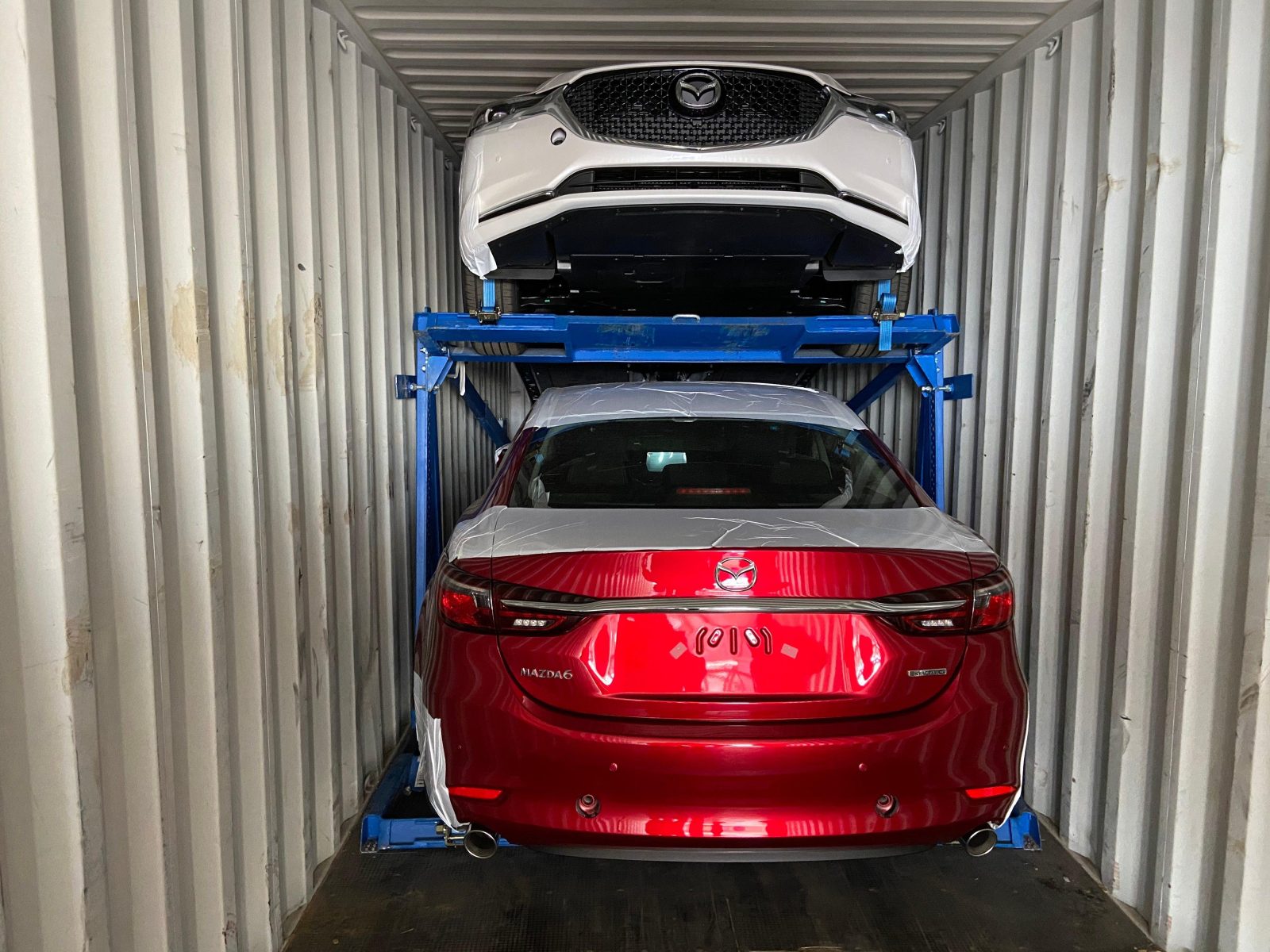
Container Shipping
Container shipping may be suitable when:
- Vehicles require enclosed transport
- Multiple vehicles can be loaded together
- Spare parts or accessories are included
- The destination has reliable container handling
- Additional protection is required
Loading plans depend on vehicle dimensions and container capacity. Large SUVs and MPVs may significantly reduce the number of vehicles that can be loaded in one container.
Ro-Ro Shipping
Roll-on/roll-off shipping may be suitable when:
- A direct vehicle route is available
- The destination port accepts Ro-Ro cargo
- Vehicle quantities justify the route
- The shipping schedule meets the buyer’s requirement
Land Transportation
Land transport may be used for Central Asia, Russia and other markets connected through inland export points.
The buyer and exporter should confirm the handover point, carrier responsibility, customs arrangement and required transit documents.
Step 8: Use a Detailed Contract and Payment Schedule
The contract or proforma invoice should state:
- Legal buyer and seller
- Vehicle model and trim
- Model year and production requirements
- Vehicle condition
- Quantity
- Unit price and total price
- Currency
- Trade term
- Named port
- Payment schedule
- Estimated delivery period
- Inspection requirements
- Included documents
- Included accessories
- Shipping responsibilities
- Warranty boundaries
- Spare-parts support
- Cancellation or replacement conditions
- Treatment of specification differences
For current PortAuto vehicle orders, a 30% deposit is generally required. Payment may be arranged by telegraphic transfer or through the Made-in-China platform according to the confirmed quotation and contract.
PortAuto does not provide open-account delivery after the bill of lading. Letter-of-credit terms are not currently accepted for standard vehicle orders.
Commercial terms should always be reconfirmed in the current quotation because availability, routes, freight and supplier conditions may change.
Step 9: Complete Vehicle Inspection Before Shipment
Inspection requirements should be agreed before the vehicle reaches the export port.
A useful pre-shipment record may include:
- VIN photo
- Odometer photo
- Production label
- Exterior walk-around video
- Interior video
- Instrument-panel startup
- Screen and language test
- Lighting test
- Air-conditioning test
- Charging test where applicable
- Tyre and wheel condition
- Included keys and accessories
- Visible body damage
- Underbody condition where required
- Loading photos and video
For higher-volume orders, buyers may also define sampling rules or arrange an independent third-party inspection.
Inspection does not replace destination homologation. It confirms the vehicle and its visible condition against the agreed sourcing scope.
Step 10: Confirm the Export Document Checklist
The exact documentation depends on the vehicle category, shipment route and destination.
Common project documents may include:
- Commercial invoice
- Packing list or vehicle list
- Bill of lading or transport document
- Export customs documentation
- Vehicle identification information
- Certificate of origin where applicable
- Available manufacturer or vehicle certificates
- Inspection records
- Insurance document where applicable
- Other documents agreed in the contract
Buyers should send destination-specific document requirements before confirming the order.
Documents that were not included in the quotation should not be assumed to be available after the vehicle has shipped.
Step 11: Prepare for After-Sales Support
Before importing intelligent electric or plug-in hybrid vehicles, consider the local ability to support:
- Routine maintenance
- Diagnostic equipment
- Software troubleshooting
- High-voltage battery systems
- Charging equipment
- Body and collision parts
- Fast-moving maintenance parts
- Technical manuals
- Remote technical communication
China-market manufacturer warranty coverage may not automatically continue after the vehicle is exported.
PortAuto can coordinate paid spare-parts supply and online technical communication according to the order agreement, but warranty and service responsibilities should be clearly recorded before payment.
Common Mistakes When Importing Cars from China
Choosing Only by Price
Different quotations may refer to different trims, model years, vehicle conditions, options or shipping scopes.
Failing to Confirm Registration History
A vehicle with almost zero mileage may still have been registered and exported as a used vehicle.
Assuming All Software Works Overseas
Navigation, eSIM, applications, OTA updates and connected functions may depend on China-based services.
Ignoring Charging Compatibility
The physical charging connector is only one issue. Voltage, frequency, communication protocol and public-network compatibility should also be checked.
Requesting Documents After Shipment
Destination-specific documentation should be discussed before the contract is signed.
Paying an Unrelated Account
The payment beneficiary should match the contracting party or have a clearly documented commercial relationship.
Treating Online Listings as Live Inventory
Vehicle availability, production date, configuration and price must be confirmed through a current quotation.
Ignoring the Responsibility Boundary
The contract should identify what the buyer, exporter, carrier, customs broker and destination agent are each responsible for.
How PortAuto Supports B2B Vehicle Import Projects
PortAuto is a China-based vehicle sourcing and export company serving professional international buyers.
Depending on the confirmed project scope, PortAuto can coordinate:
| Service | Project Scope |
| Vehicle sourcing | New, used, electric, hybrid, fuel and project vehicles |
| Configuration confirmation | Trim, model year, powertrain, seating, colour and options |
| Vehicle evidence | VIN, photos, videos and available supporting records |
| B2B quotation | Current vehicle and logistics scope |
| Export documentation | Commercial and export-side document coordination |
| Vehicle inspection | Agreed inspection points and visual records |
| China logistics | Transport to the agreed export point |
| International transport | Container, Ro-Ro or land shipping coordination |
| Charging accessories | Adapters and cables based on project requirements |
| Spare parts | Maintenance and project-specific parts packages |
| After-sales communication | Online technical coordination and paid parts support |
PortAuto’s export process follows five main stages: requirement definition, sourcing, verification, documentation and logistics. Responsibilities are confirmed before each major handover.
Information Needed for a B2B Vehicle Quotation
To receive a workable quotation, send:
- Company name and buyer type
- Destination country
- Destination port or city
- Brand and model
- Required trim and model year
- New or used condition
- Quantity
- Exterior and interior colour
- Required options
- Software language requirement
- Charging requirement
- Preferred FOB or CIF term
- Required delivery period
- Destination-specific documents
The more complete the requirement, the more accurately the vehicle, commercial scope and responsibility boundary can be confirmed.
Frequently Asked Questions
Can I import a factory-new car from China?
Yes, subject to the model, supply channel, export conditions and destination requirements. State clearly whether the vehicle must be factory-new, never registered and never used for demonstration or commercial purposes.
Are all zero-mileage vehicles classified as new?
No. A vehicle may have very low mileage but still have a previous registration record. Vehicle condition and registration history should be confirmed separately.
Can PortAuto provide FOB or CIF prices?
Yes. PortAuto can prepare FOB or CIF quotations according to the vehicle location, export port, shipping route, quantity and destination.
Does PortAuto offer DDP delivery?
PortAuto normally focuses on FOB or CIF vehicle export. The buyer is responsible for destination customs clearance, import taxes, local registration and other destination-side requirements unless otherwise stated in a specific written agreement.
Can China-market vehicles support English?
Some vehicles support English, but the exact interface, navigation, voice, application and connected-service functions must be checked on the actual model and software version.
Will the Chinese manufacturer warranty work overseas?
It may not. China-market manufacturer warranty coverage does not automatically apply in every overseas market. Warranty, paid spare-parts support and technical communication should be confirmed in the contract.
Can charging adapters be included?
Yes. Charging adapters, cables and other accessories can be added according to the destination and vehicle requirements. Compatibility should be confirmed before shipment.
What payment methods does PortAuto accept?
Standard vehicle projects currently use telegraphic transfer or the Made-in-China platform. PortAuto does not currently accept standard LC or open-account payment terms.
Is there a minimum order quantity?
There is no single minimum quantity for every vehicle. Sample-order availability, wholesale pricing and shipping feasibility depend on the model, supply channel and destination.
Does a brand logo on the website mean PortAuto is an authorised dealer?
Not automatically. Brand listings describe potential sourcing coverage. Any official authorisation or export-partner status should be stated separately and supported by verifiable documentation.
How do I request a quotation?
Send the destination, model, trim, condition, quantity, delivery period and preferred trade term through the PortAuto B2B inquiry form.
Request a Vehicle Import Quotation
Planning to import Chinese vehicles for a dealership, distribution network, fleet or automotive project?
Send PortAuto your destination market, required models, quantity, configuration and delivery timeline. Our team will identify the vehicle, evidence, documentation, logistics and commercial points that must be confirmed before preparing a current quotation.
Email: info@portauto.com
China Phone: +86 175 0581 7107
PortAuto
China Vehicle Sourcing and B2B Export Solutions
Important Notice: This article provides general sourcing and export information. Vehicle availability, specifications, regulations, licences, documents, freight, commercial terms and destination suitability must be confirmed for each current project.