When dealers ask about shipping vehicles from China, one of the most common questions is:
How many cars can fit in a 40HQ container?
The simple answer is:
There is no single fixed number.
A 40HQ container may carry two large SUVs in a relatively straightforward loading arrangement, while smaller vehicles may allow a higher loading density when professional vehicle-loading equipment is used.
The final quantity depends on the exact dimensions of each vehicle, the loading method, available clearance, securing points and the container supplied for the shipment.
For importers, this means that vehicle quantity should never be confirmed from the words “40HQ container” alone.
A proper loading plan should be calculated using the actual vehicles being shipped.
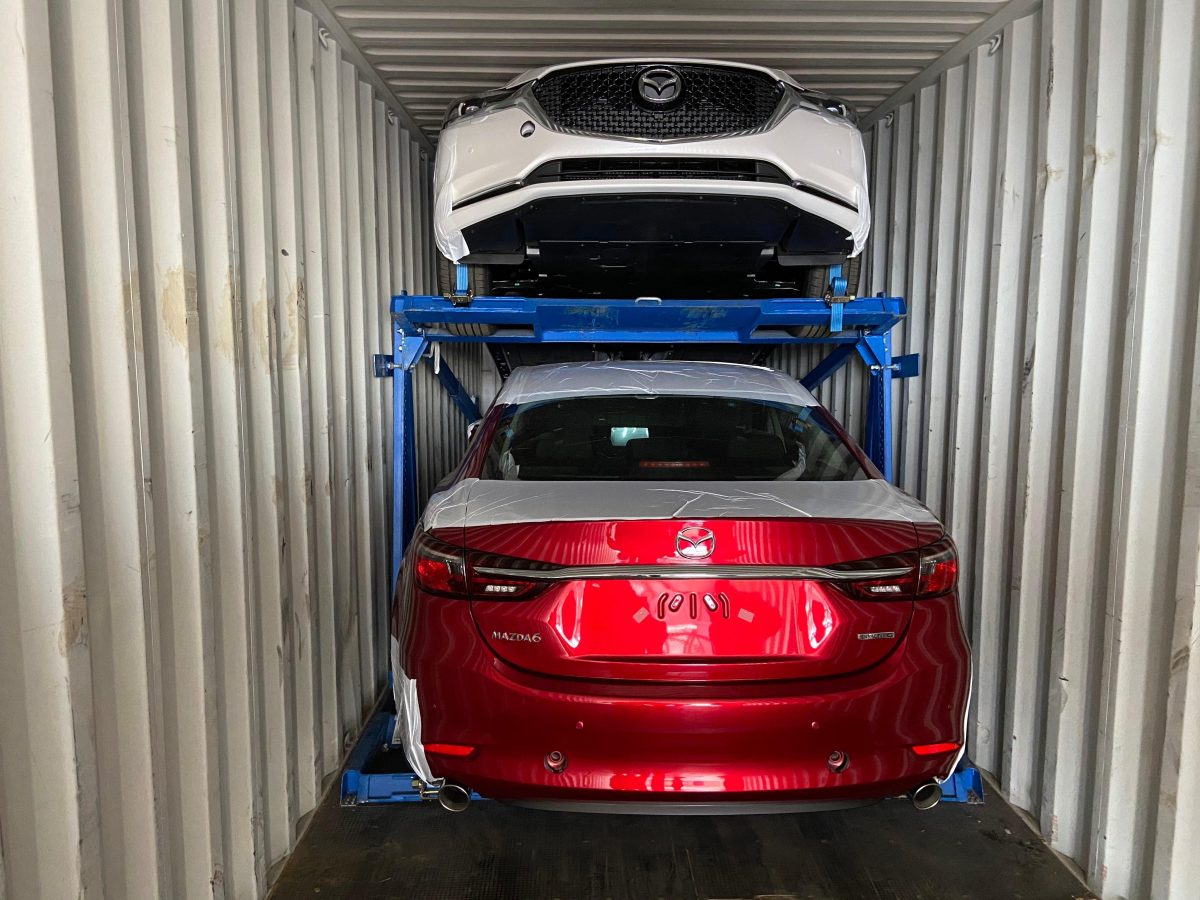
Quick Answer: How Many Cars Can Fit in a 40HQ Container?
As a practical starting point:
| Vehicle Type | Typical Planning Scenario | Important Note |
|---|---|---|
| Large SUV / Large MPV | Around 2 vehicles | Common with straightforward loading |
| Standard SUV | Usually 2 with simple loading; more may be possible with specialist systems | Exact dimensions must be checked |
| Sedan | 2–4 depending on dimensions and loading system | Racking or angled loading may be required |
| Compact Car | Higher density may be possible | Requires a professional loading plan |
| Mixed Models | Case-by-case | Every model must be calculated separately |
These are planning examples, not guaranteed loading quantities.
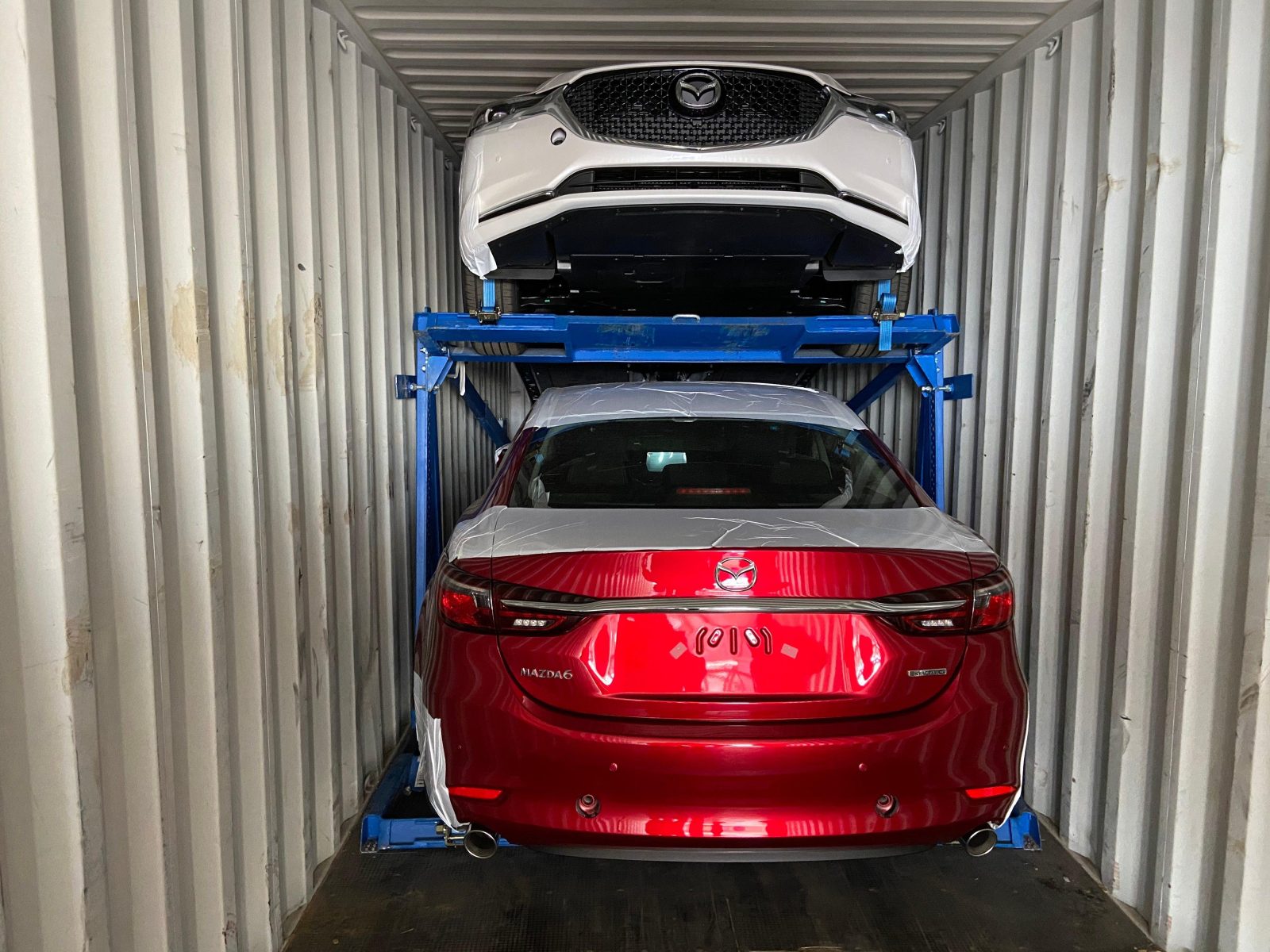
Three or four vehicles inside one container normally require much more than simply driving the vehicles into the box. Professional racks, raised platforms or specially engineered loading arrangements may be necessary.
For large models such as full-size SUVs and luxury MPVs, vehicle length and height can quickly become the limiting factors.
What Is a 40HQ Container?
A 40HQ, also called a 40-foot High Cube container, is one of the most commonly used container types in international trade.
Compared with a standard 40-foot container, the High Cube provides additional internal height.
A Hapag-Lloyd 40-foot Standard High Cube example lists approximately:
| Specification | Approximate Dimension |
|---|---|
| Internal Length | 12,032 mm |
| Internal Width | 2,350 mm |
| Internal Height | 2,700 mm |
| Door Width | 2,340 mm |
| Door Height | 2,597 mm |
| Capacity | 76.3 m³ |
| Maximum Payload | 28,600 kg |
The carrier specifically notes that actual container dimensions can vary depending on the manufacturer, so these values should be treated as representative rather than universal.
That variation matters when shipping vehicles.
A difference of only a few centimeters can affect mirror clearance, roof clearance, loading-rack positioning or whether a particular vehicle can safely enter through the container door.
Why You Cannot Calculate Vehicle Capacity Using Length Alone
At first glance, calculating how many vehicles fit into a container seems simple.
For example:
Container length ÷ vehicle length = number of vehicles.
In reality, vehicle loading does not work this way.
Several additional factors must be considered.
1. Vehicle Length
A large SUV may be more than 5 meters long.
Two vehicles can already use most of the available internal container length once safe spacing and securing requirements are included.
A compact vehicle creates more possibilities, but additional cars may still require a different loading arrangement.
2. Vehicle Width
The container’s internal width is approximately 2.35 meters in the Hapag-Lloyd High Cube example.
Modern SUVs can be close to or above 2 meters wide when mirrors are included.
That leaves relatively little space for:
- Opening doors
- Driver access
- Wheel positioning
- Protective materials
- Side clearance
- Loading equipment
The vehicle may fit mathematically but still be difficult to load safely.
3. Vehicle Height
Vehicle height becomes particularly important when using elevated loading racks.
An SUV may easily measure around 1.7–1.9 meters high.
A 40HQ provides useful additional vertical space, but it does not mean that two SUVs can simply be stacked vertically.
The rack angle, roof profile, suspension position and clearance between vehicles all have to be calculated.
4. Wheelbase and Ground Clearance
Loading systems frequently place a vehicle on an incline.
A long-wheelbase vehicle with low ground clearance may contact:
- Loading ramps
- Steel frames
- Container floors
- Rack transitions
This is particularly important for performance sedans and low-suspension vehicles.
5. Vehicle Weight
Passenger vehicles are normally well below the total payload limit of a 40HQ container, but the complete load still needs to account for:
- Vehicle weight
- Loading-frame weight
- Securing equipment
- Accessories
- Spare parts
- Other cargo
Weight distribution also matters.
The goal is not simply to stay below the maximum payload.
The load must be positioned and secured correctly.
Large SUVs: Why Two Vehicles Are Often the Starting Point
Large Chinese SUVs and luxury vehicles have become increasingly popular in international sourcing projects.
Examples of the type of vehicle that requires careful loading calculation include:
- ZEEKR 9X
- Lynk & Co 900
- AITO M9
- Li Auto L9
- YANGWANG U8L
- Other full-size SUVs and MPVs
For vehicles in this size class, two units per 40HQ is often a practical starting point for a conventional loading assessment.
That does not mean every two large SUVs automatically fit.
PortAuto checks the dimensions of the exact vehicles before confirming the loading arrangement.
Important data includes:
Length × Width × Height
plus:
- Curb weight
- Wheelbase
- Ground clearance
- Tyre position
- Roof accessories
- Side steps
- Mirrors
- Vehicle body shape
Large vehicles equipped with electric side steps, roof equipment or special exterior packages may require additional clearance.
Can Three SUVs Fit in a 40HQ Container?
Possibly—but this should never be assumed.
Three standard-size SUVs generally cannot simply be parked one behind another on the container floor because the combined vehicle length will usually exceed the usable internal length.
A three-vehicle solution therefore normally requires a more specialized arrangement.
This may include:
- Angled loading
- Raised loading platforms
- Professional vehicle racks
- Different front/rear orientations
The actual feasibility depends on the three vehicles involved.
For example, a shipment containing:
1 large SUV + 2 compact SUVs
is a completely different loading problem from:
3 full-size SUVs.
Therefore, when an exporter says:
“A 40HQ can load three cars.”
The importer should ask:
Which three cars?
That is the question that matters.
Can Four Cars Fit in a 40HQ Container?
For some compact cars and smaller passenger vehicles, a professional four-car loading solution may be possible.
However, four vehicles should never be treated as the standard capacity of every 40HQ container.
Higher-density vehicle loading generally involves specialist racks or elevated positioning.
The loading provider must verify:
- Vehicle dimensions
- Vehicle weight
- Rack capacity
- Vehicle angle
- Roof clearance
- Ground clearance
- Door clearance
- Wheel securing points
- Load distribution
- Safe unloading at destination
A solution that works for four compact vehicles may be completely unsuitable for four SUVs.
Flat Loading vs Professional Racking
There are two fundamentally different approaches to vehicle container loading.
Flat Loading
With flat loading, vehicles remain primarily on the container floor.
Advantages
- Simple loading process
- Fewer structural loading components
- Easy vehicle positioning
- Suitable for larger SUVs
- Easier unloading at destination
- Lower complexity
Limitations
The primary limitation is space utilization.
Because the vehicles occupy the full floor length, fewer units can normally be loaded.
For expensive, heavy or very large vehicles, however, simplicity may be preferable to maximizing the number of units inside one container.
Rack or Elevated Loading
Professional vehicle-loading systems can use the vertical space inside the container.
One vehicle may be raised or positioned at an angle while another occupies the space below or behind it.
This can significantly improve container utilization.
However, the process requires professional equipment and planning.
The loading company must consider:
- Vehicle weight
- Chassis position
- Ramp angle
- Wheel support
- Suspension compression
- Roof clearance
- Underbody clearance
- Rack strength
- Lashing
- Loading sequence
- Destination unloading equipment
Higher loading density should never come at the cost of vehicle damage.
Why the Container Door Is Important
One detail buyers often overlook is the container door opening.
In the Hapag-Lloyd 40HQ example, the internal height is around 2,700 mm, while the door opening height is around 2,597 mm.
So the usable interior may be higher than the entrance.
This distinction is especially important for:
- Tall SUVs
- MPVs
- Vehicles on loading racks
- Vehicles with roof accessories
- Raised suspension vehicles
A loading plan must confirm that the vehicle can physically pass through the door before considering how it will be positioned inside.
Can Different Car Models Be Loaded in the Same Container?
Yes.
For B2B vehicle buyers, mixed-model loading can be very useful.
A shipment might contain:
- One premium SUV
- One compact SUV
- One sedan
or vehicles from several Chinese brands.
For example:
ZEEKR + Lynk & Co + Geely
may be sourced within the same broader purchasing project.
But mixed-model loading requires more planning than loading identical vehicles.
The loading company needs the exact dimensions of each VIN-level vehicle or confirmed configuration, because one larger vehicle can change the entire loading arrangement.
A mixed order should therefore distinguish between:
Purchasing quantity
and
Container loading quantity.
Buying ten vehicles does not automatically mean they can be divided into containers using the same number per container.
Mixed-Model Container Example
Consider an importer purchasing:
| Vehicle | Quantity |
|---|---|
| Large SUV | 2 |
| Compact SUV | 3 |
| Sedan | 3 |
| Total | 8 |
The buyer should not simply calculate:
8 vehicles ÷ 4 cars per container = 2 containers.
Instead, the exporter and loading company should determine the most workable combination.
One possible project may require:
Container A
2 large SUVs
Container B
A combination of smaller vehicles using an approved loading system
Or a different solution may be more practical depending on vehicle size and route.
The purpose of the loading plan is to determine this before the vehicles reach the final loading stage.
Container Shipping vs RoRo Shipping
Container transport is not the only method available for exporting vehicles from China.
Another major option is RoRo — Roll-on/Roll-off shipping.
The correct choice depends on the route, quantity, vehicle value and sailing schedule.
Container Shipping
Container shipping may be attractive when:
- Shipping a limited number of vehicles
- Combining different models
- Shipping high-value vehicles
- Additional protection is preferred
- Accessories or permitted spare parts are included
- The destination has suitable container handling
- No convenient RoRo service is available
The container provides an enclosed transportation environment once sealed.
RoRo Shipping
RoRo vessels are specifically designed so vehicles can be driven onto and off the vessel.
RoRo may be attractive when:
- Shipping larger quantities
- A suitable RoRo route exists
- The origin and destination ports support the service
- Vehicles are operational
- The sailing schedule matches the project
RoRo is widely used by the automotive industry for vehicle transportation.
However, it should not automatically be described as cheaper than container shipping.
The actual cost depends on factors including:
- Route
- Vehicle dimensions
- Carrier
- Port
- Season
- Freight market
- Sailing schedule
- Local charges
A current quotation is required.
Container vs RoRo: Quick Comparison
| Factor | 40HQ Container | RoRo |
|---|---|---|
| Small-volume orders | Often practical | Route dependent |
| Mixed-model orders | Flexible | Possible |
| Large-volume orders | More containers required | Often worth evaluating |
| Vehicle enclosure | Enclosed in container | Vehicle deck |
| Spare parts | May be possible subject to shipping rules | More restricted project structure |
| Route availability | Broad container network | Depends on RoRo services |
| Loading calculation | Important | Vehicle dimensions still required |
| Sailing schedule | Container service schedule | Specific RoRo schedule |
| Cost | Route-specific | Route-specific |
Neither option is universally better.
The correct answer is project-specific.
What Information Is Needed for a Vehicle Loading Plan?
Before PortAuto evaluates a shipment, the following information is useful.
Vehicle Information
For every model:
- Brand
- Model
- Trim
- Quantity
- Length
- Width
- Height
- Wheelbase
- Curb weight
- Ground clearance
- Exterior accessories
Shipment Information
The buyer should also provide:
- Destination country
- Destination port
- Required delivery period
- FOB or CIF requirement
- Container preference
- Whether mixed loading is acceptable
- Whether spare parts or accessories are included
With this information, the sourcing and logistics teams can determine which loading options should be evaluated.
Do Electric Vehicles Require Different Shipping Planning?
EVs are routinely transported internationally, but their powertrain and battery characteristics must be correctly declared and handled according to the applicable transport requirements.
For container projects, the exporter, carrier and logistics provider should confirm the current requirements for the exact vehicle and route.
An importer should therefore avoid assuming:
EV + container = exactly the same procedure on every shipping line.
Carrier acceptance requirements and documentation should be confirmed during shipment planning.
Can Spare Parts Be Loaded With the Vehicles?
Potentially, but this should be discussed before booking.
Possible project cargo may include items such as:
- Charging cables
- Approved charging adapters
- Floor mats
- Maintenance parts
- Accessories
However, the exporter must first confirm whether the items are acceptable for the selected carrier and shipment.
Large loose items should never simply be placed around the vehicle without an agreed securing plan.
Cargo movement inside the container can damage both the vehicle and the additional goods.
Why Loading Photos and Videos Matter
For B2B buyers, vehicle evidence should not stop once the cars arrive at the port.
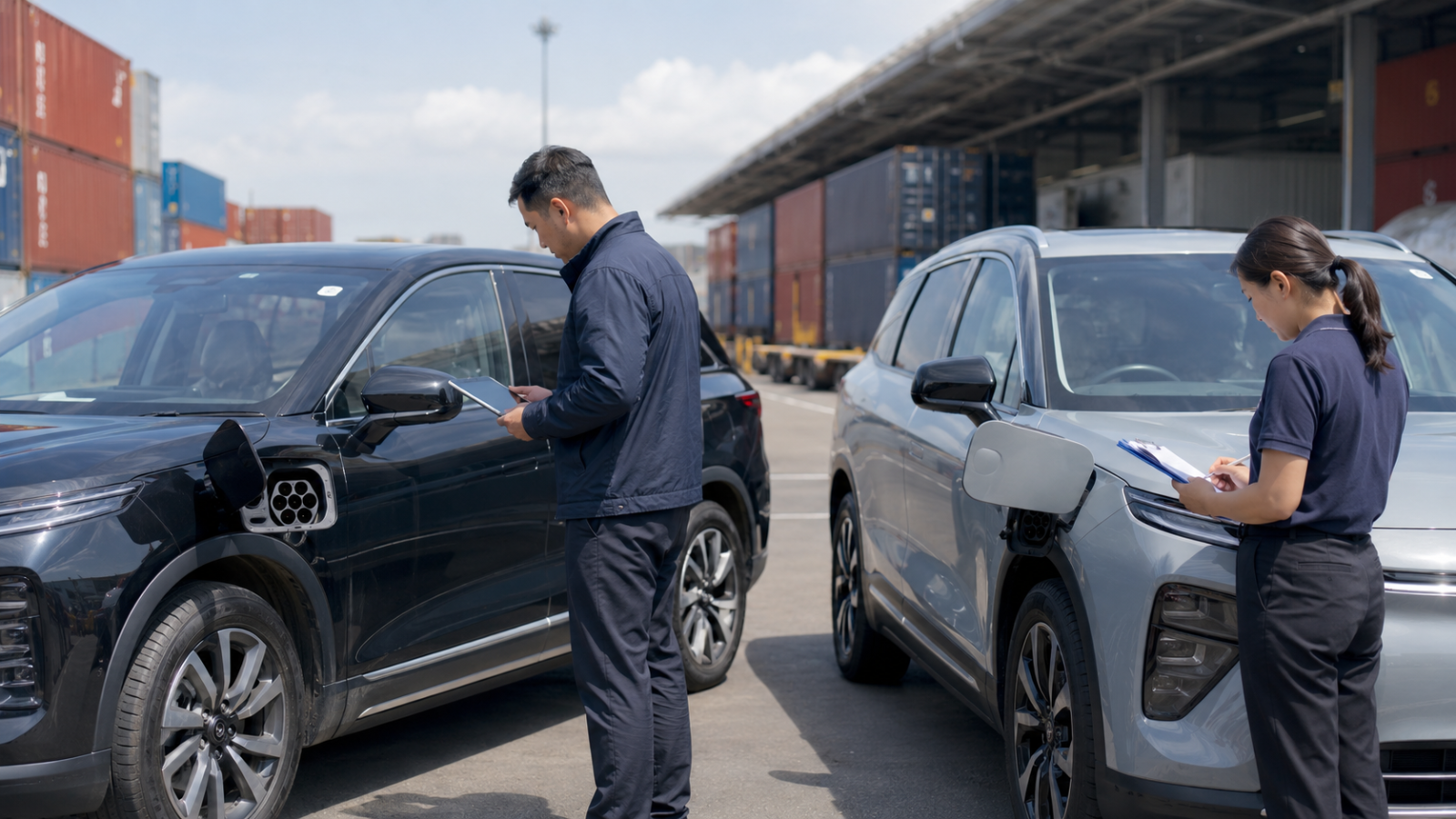
A useful shipment record may include:
- VIN photos
- Exterior condition photos
- Odometer record
- Container number
- Empty-container condition
- Loading process
- Vehicle positioning
- Lashing and securing
- Final loading condition
- Container seal number
This gives both buyer and seller a clearer record of the handover stage.
PortAuto Vehicle Shipping Process
PortAuto coordinates vehicle sourcing and export projects for overseas dealers, distributors, fleet operators and automotive trading companies.
A typical shipping project can be divided into the following stages:
1. Vehicle Requirement
Confirm:
- Model
- Trim
- Quantity
- Colour
- Powertrain
- Destination
2. Vehicle Confirmation
Confirm available vehicles and configurations.
3. Vehicle Dimension Check
Collect the technical information required for loading.
4. Loading Plan
Evaluate:
- Vehicle combination
- Container type
- Loading method
- Clearance
- Securing method
5. Export Preparation
Prepare the agreed export-side vehicle and commercial documentation.
6. Port Delivery
Vehicles are transported to the agreed export location.
7. Loading and Evidence
Record the agreed loading and handover evidence.
8. International Shipping
Arrange the agreed container, RoRo or other applicable logistics service.
This process allows vehicle procurement and shipping to be planned together rather than treating logistics as an afterthought.
Frequently Asked Questions
How many SUVs fit in a 40HQ container?
For large SUVs, two vehicles are often a practical starting point for a conventional loading assessment.
Smaller SUVs may permit other arrangements with professional racks or elevated loading systems.
The exact vehicle dimensions must be checked before confirming capacity.
Can three SUVs fit in a 40HQ container?
Possibly, depending on their size and the loading system.
Three standard SUVs generally require more planning than simple floor loading, and three full-size SUVs should not be assumed to fit.
Can four cars fit in a 40ft container?
Certain compact vehicles may allow four-car professional loading arrangements.
This is not a universal 40HQ capacity.
The vehicle dimensions, loading rack and securing arrangement must first be verified.
Can two large SUVs fit in one 40HQ?
In many projects, two large SUVs may be considered for one 40HQ, but the exact model dimensions, loading clearance and securing plan still need to be confirmed.
Can different vehicle brands share one container?
Yes, mixed-model or multi-brand container shipping may be possible.
The loading plan should use the dimensions of the exact models included in that shipment.
Is 40HQ better than 40GP for shipping cars?
The additional height of a 40HQ can be useful for vehicles and professional loading systems.
However, the required container type depends on the actual loading design.
Is RoRo cheaper than container shipping?
Not always.
Freight rates depend on route, carrier, port, vehicle dimensions, sailing availability and current market conditions.
Both options should be compared using current quotations.
Can electric vehicles be shipped in containers?
Yes, electric vehicles are transported internationally by container, but the shipment must comply with the applicable carrier and transport requirements.
Requirements should be checked for the actual vehicle and route before booking.
Can accessories or spare parts be put in the container?
In some projects, yes.
The items must be declared where required, accepted by the carrier and properly secured.
Confirmation should be obtained before loading.
What information should I send for a container-loading quotation?
Send:
- Vehicle brand and model
- Exact trim
- Quantity
- Destination country
- Destination port
- Preferred shipping method
- Expected shipping date
If the project includes multiple models, list the required quantity for every model separately.
Request a Vehicle Shipping and Loading Plan From China
Planning to purchase and ship vehicles from China?
Send PortAuto your:
Models + Quantity + Destination Port + Preferred Shipping Method
Our team can coordinate the vehicle sourcing requirement and evaluate the appropriate logistics arrangement based on the actual project.
Whether your order contains two large SUVs, several compact vehicles or a mixed-model wholesale shipment, the loading plan should be based on the real vehicle dimensions rather than a generic “cars per container” number.
PortAuto
China Vehicle Sourcing & B2B Export Solutions
WhatsApp: +1 (310) 876-6843
WeChat: portauto_
Phone: +86 175 0581 7107
Email: info@portauto.com
Website: www.portauto.com
Important Notice: Container dimensions vary by equipment manufacturer, and vehicle-loading feasibility depends on the exact vehicle, container, loading equipment, carrier and route. Loading quantities shown in examples are for planning purposes only and must be reconfirmed for every shipment.
Turn the research into a sourcing requirement.
Share the market, vehicle scope, quantity and timeline for a project-specific discussion.
Before requesting a quotation
Confirm the project variables behind the article.
Vehicle
Model year, trim, configuration, condition and quantity.
Market
Destination, intended use, buyer inputs and applicable requirements.
Evidence
Supplier, vehicle, specification and document checks required.
Commercial scope
Current availability, timing, trade terms and responsibility boundary.