Before placing a wholesale vehicle order, ask a question that goes beyond price and delivery:
What will happen when the first customer needs maintenance, a replacement part or help with a vehicle fault?
For a dealership, this question belongs in the purchasing discussion—not in an urgent message after the vehicle has already reached the customer.
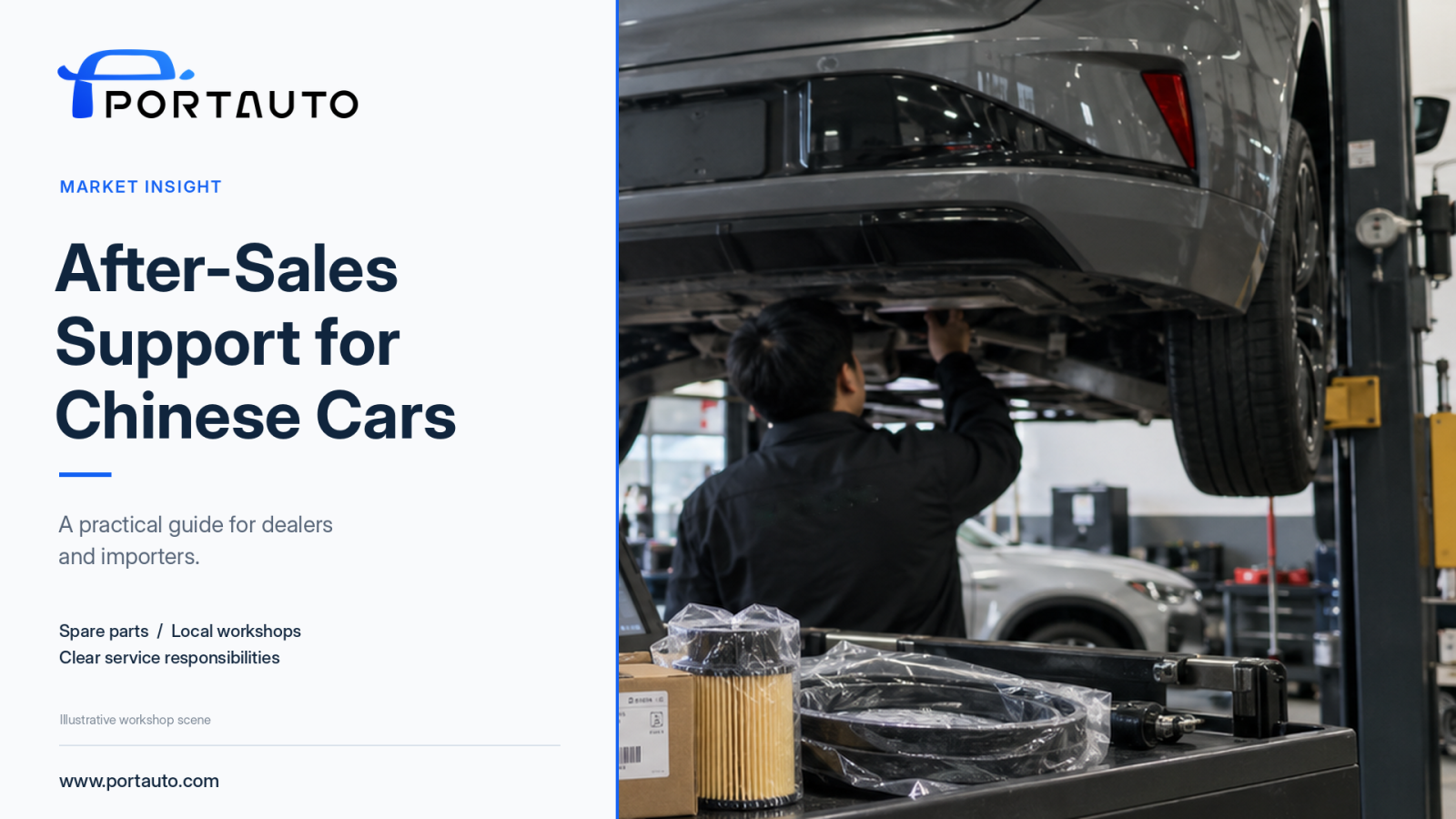
After-sales support for Chinese cars should connect several practical elements: a local workshop capable of working on the vehicle, an accurate parts-identification process, access to appropriate technical information, and a clear agreement about who approves and pays for each service.
A supplier’s ability to source a replacement part is useful. It is not, by itself, a complete repair arrangement.
This guide explains how dealers, distributors and fleet importers can prepare an after-sales plan before delivery, then use real service experience to improve it.
What Should After-Sales Support Include?
For planning purposes, separate after-sales support into four areas.
| Support Area | What the Dealer Should Establish |
|---|---|
| Local maintenance and repair | A workshop responsible for physical inspection, maintenance, installation and repair verification |
| Spare-parts supply | A process for identifying the correct item, confirming availability and arranging delivery |
| Technical communication | A way to share symptoms, inspection findings and vehicle-specific information with the appropriate support provider |
| Warranty and cost responsibility | Written confirmation of applicable coverage, approval requirements and charges |
These areas may involve different organizations.
For example, ZEEKR’s European service information distinguishes trained service technicians, authorized workshops and genuine replacement parts within its own service network. That describes a particular manufacturer-operated arrangement; it should not be assumed to cover every independently imported ZEEKR vehicle.
For an independent importer, the practical task is to establish which services are actually available for the vehicles being purchased.
Before advertising after-sales support, identify the provider, the scope and the conditions behind the promise.
Prepare a Local Workshop Before the First Delivery
Start with the workshop that will receive the vehicle when a customer needs assistance.
Ask the workshop to assess the exact models and powertrains in the proposed order. The discussion should cover scheduled maintenance, diagnostic access, replacement-part installation and any work that would need referral to another specialist.
For electric and hybrid vehicles, workshop capability needs particular attention. The UK Health and Safety Executive explains that working safely on these vehicles can require additional training, specialist equipment and manufacturer-specific information. The required competence depends on the work being performed.
A workshop assessment should therefore go beyond asking, “Do you repair electric cars?”
Discuss whether the workshop has appropriate information and equipment for the intended models, which tasks its technicians are qualified to perform, and how it will handle work outside that scope.
High-voltage inspection and repair must be left to appropriately trained personnel following the relevant vehicle procedures. Remote messages are not a substitute for a safe, competent local repair operation.
For each vehicle delivered, create a service record containing the VIN, configuration, delivery date, mileage and available maintenance information. Add subsequent inspections and repairs to the same record.
Build a Parts Plan Around the Vehicles You Actually Sell
Avoid ordering a generic “Chinese car spare-parts package” before reviewing the vehicles in your inventory.
Begin with the applicable maintenance schedule. Battery-electric vehicles generally require less scheduled maintenance than vehicles with combustion engines, while plug-in hybrids and conventional hybrids retain engine-related maintenance requirements. The U.S. Department of Energy’s Alternative Fuels Data Center makes this distinction in its maintenance guidance.
That does not produce one universal parts list. It gives the dealer a reason to plan separately by model and powertrain.
The following table is a suggested purchasing framework, not a mandatory stocking list or a statement of PortAuto inventory.
| Parts Category | Examples to Assess | Suggested Planning Approach |
|---|---|---|
| Scheduled-service items | Cabin filters, wiper blades and applicable engine-service filters | Review against the exact maintenance schedule and expected service demand |
| Wear-related items | Brake components and other model-specific wear items | Decide quantities using inspection findings and local service history |
| Exterior repair items | Lamps, mirrors, trim pieces and body components | Establish a sourcing route before deciding whether local stock is justified |
| Electronic components | Sensors, displays and control modules | Confirm diagnosis, exact compatibility and installation requirements before purchase |
| Major assemblies | Traction batteries, drive units and other substantial assemblies | Assess individually with specialist repair, handling and transport requirements |
For a new dealership, start with a limited, documented plan. Expand it when completed service jobs show which items are repeatedly required.
A useful question is:
Would holding this item locally solve a recurring service need, or would it simply create another part on the shelf?
Also distinguish local availability from China-side availability. A supplier confirming that an item can be ordered is not the same as confirming that it is ready for immediate dispatch.
Identify Spare Parts Using More Than the Model Name
A request such as “headlight for a Chinese SUV” is not sufficient for a reliable parts quotation.
Use the exact vehicle identity and the relevant part information. Professional parts-identification systems use vehicle details and original-equipment part numbers; HELLA’s parts finder, for example, supports vehicle identification and OE-number searches.
For imported vehicles, the VIN should be the starting point of the request, supported by the existing part number and photographs where available.
Ask the supplier to confirm compatibility rather than treating a similar photograph as proof.
Information Required for a Spare-Parts Request
| Information | What to Provide |
|---|---|
| Vehicle identity | Brand, model, model year, trim and powertrain |
| VIN | The full vehicle identification number, preferably accompanied by a clear photograph |
| Production information | Production date and relevant configuration details |
| Required item | Part name and precise installation position, including left or right where applicable |
| Part number | Number shown on the existing component or verified parts record; mark it as unknown when unavailable |
| Photographs | The component, its label and its installation location |
| Reason for replacement | Scheduled maintenance, physical damage or a diagnosed fault |
| Quantity and destination | Number of items required and destination country and city |
| Workshop contact | The person responsible for confirming the repair requirement and receiving technical questions |
Do not guess an unreadable part number. Send a clear photograph and request verification.
Where an alternative or replacement part number is proposed, ask the supplier to explain the substitution and confirm suitability before approval.
The objective is not merely to obtain a price. It is to identify the item that the workshop can use on the actual vehicle.
Diagnose the Problem Before Ordering an Expensive Component
Keep a customer’s description, a workshop’s diagnosis and a parts order as three separate stages.
A message saying “the vehicle will not charge” should open a service case. It should not automatically become an order for a replacement charging component.
Ask the local workshop to document what it has inspected, the symptoms it has confirmed and the information supporting its proposed repair. For an electronic issue, request the available diagnostic report and relevant vehicle-software information.
Before ordering a component, the dealer should be able to answer:
What evidence supports replacing this item, and who will confirm that the repair has solved the original problem?
Also ask whether installation requires programming, calibration or other vehicle-specific procedures, and whether the intended workshop can complete them.
Technical support is most useful when it receives a clearly documented problem. HELLA’s workshop-support model, for example, combines technical assistance with information about vehicle systems, fault diagnosis and repair—not simply a request to purchase parts.
Do not promise that every electronic issue can be resolved remotely or by installing a replacement component.
Use a Service Workflow With Clear Ownership
A dealership does not need a complicated system to begin handling after-sales requests. It needs a consistent record and an assigned next action.
The following is a suggested workflow for importers to adapt to their own operations.
| Stage | Action | Record to Keep |
|---|---|---|
| Customer report | Record the concern and arrange appropriate local assessment | VIN, mileage, date, symptoms and customer contact |
| Workshop assessment | Establish findings and identify whether further technical assistance is needed | Inspection notes, photographs and diagnostic information |
| Repair proposal | Define the proposed work, parts and unresolved questions | Repair recommendation and compatibility confirmation |
| Approval | Confirm the scope, cost responsibility and applicable coverage before proceeding | Written approval or claim decision |
| Parts supply and repair | Track the confirmed parts order and local workshop work | Order details, shipping records and repair invoice |
| Completion | Confirm the original concern has been addressed and communicate the result | Workshop verification, customer update and case closure |
Assign one person within the dealership to coordinate the case.
That person should know whether the next action belongs to the customer, workshop, parts supplier or another support provider. A case should not remain marked only as “waiting” without explaining what is missing.
Separate an acknowledgment from a resolution commitment. You can agree when the customer will receive the next update without inventing a repair-completion date before diagnosis.
Separate Manufacturer Warranty From Paid Support
A parts-sourcing service and a manufacturer warranty are different arrangements.
Warranty eligibility needs to be checked against the actual vehicle, market and applicable terms. For example, ZEEKR’s published Swedish warranty terms identify vehicles sold, registered and operated in Sweden and set out maintenance and other conditions. Those terms should not be presented as a universal warranty for China-market vehicles exported through another channel.
Before making a customer-facing promise, obtain written answers about the coverage being offered.
Confirm who provides it, which vehicles qualify, how a claim is submitted and who authorizes work. Clarify whether the arrangement covers parts, diagnosis, local labour, transport or only selected items.
Where a manufacturer-backed overseas warranty has not been confirmed, describe the available support accurately—for example, paid spare-parts sourcing and technical communication within an agreed scope.
Do not call this “global manufacturer warranty.”
Likewise, a workshop’s warranty on its own installation work should not be confused with a warranty on the complete vehicle.
Plan Parts Delivery and Repair Timing Separately
“Available in China” and “ready for the customer” are different milestones.
For each parts order, request an estimated dispatch date after the correct item and availability have been confirmed. Then assess transport, destination handling and the workshop’s installation schedule separately.
Use the following sequence when communicating with the customer:
Part identification → availability confirmation → dispatch → arrival → workshop repair → final verification
This makes it easier to explain what is known and what still needs confirmation.
Request packaging details for fragile or bulky items, and arrange receiving photographs so that the shipment’s condition is recorded before installation.
Batteries require separate attention. IATA’s air-transport guidance treats battery shipments according to their characteristics and applicable dangerous-goods requirements, including identification, packaging, marking and documentation. Do not assume that a replacement traction battery can be shipped like an ordinary parcel.
Have a qualified logistics provider confirm acceptance and the transport requirements for the actual item and route before promising delivery.
Make the Cost Breakdown Visible Before Approval
For a paid repair, separate the parts quotation from the complete service estimate.
The dealership should identify which party is quoting and approving each relevant item: diagnosis, replacement parts, packaging, freight, destination charges, installation and any required setup or calibration.
This is particularly useful when the exporter supplies the part but an independent local workshop performs the repair.
Agree how additional work will be handled. A workshop discovering another problem should have a clear approval route rather than treating the original quotation as unlimited permission to proceed.
Also clarify the procedure for incorrect, damaged or disputed parts before ordering. Record the evidence required and whether the supplier has authorized a return.
A transparent estimate allows the customer to understand what has been approved and helps the dealer avoid making commitments on behalf of another service provider.
Use Service Records to Improve the Next Vehicle Order
After-sales information should feed back into purchasing.
Review which models generate repeated parts requests, which items take longer to obtain and which service tasks require outside specialists. Distinguish a confirmed product issue from accidental damage, routine wear, a maintenance concern or an unresolved diagnosis.
Track the stages of each case rather than only the total time.
A delay before diagnosis calls for a different response from a delay after the correct part has shipped. Similarly, a wrong-part order is a different problem from a workshop being unable to perform the required installation.
Use these findings to update the local parts plan, workshop arrangements and questions asked before the next vehicle purchase.
The aim is not to stock every possible component. It is to make the dealership’s service decisions better informed.
How PortAuto Supports Dealer After-Sales Planning
PortAuto’s vehicle sourcing services are organized around the buyer’s market, vehicle configuration, quantity and project requirements. After-sales expectations should be included in that discussion before the order is finalized.
For agreed projects, PortAuto can coordinate paid spare-parts support and online technical communication where available. Common maintenance and spare-parts requirements can be reviewed for dealers, distributors and fleet buyers, with the scope confirmed in the sales agreement.
Parts requests should identify the specific vehicle and required component. Availability, compatibility, charges and delivery arrangements need confirmation for each request.
Physical inspection, maintenance and repair should be arranged through the buyer’s qualified local workshop or service partner. Online assistance does not replace local diagnosis or automatically include manufacturer-authorized software access.
PortAuto’s support should not be interpreted as an automatic overseas manufacturer warranty. Any applicable warranty and service commitments must be stated separately in writing.
Frequently Asked Questions
Can dealers source replacement parts for Chinese cars from China?
A sourcing request can be assessed using the exact vehicle and part information. PortAuto offers project-specific paid spare-parts support, but availability should be confirmed for each item rather than assumed across an entire brand or model range.
What information should I send for a parts quotation?
Send the VIN, model and configuration, required part, quantity and destination. Include the existing part number, photographs and the workshop’s findings where available. Identify anything that remains uncertain instead of guessing.
Do Chinese electric vehicles still need maintenance?
Yes. Battery-electric vehicles generally have fewer scheduled maintenance requirements than combustion-engine vehicles, but they still require the checks and servicing specified for the model. Plug-in hybrids also retain engine-related maintenance requirements. Follow the applicable manufacturer schedule.
Should a new dealer buy a large spare-parts inventory immediately?
This guide recommends starting with a limited, model-specific plan based on maintenance needs, available local supply and the vehicles being sold. Expand stock using actual service demand rather than purchasing every suggested item in advance.
Can remote support replace a local repair workshop?
No. Treat remote communication as assistance to the local service process. Physical inspection, installation and repair verification need an appropriately capable workshop, with additional competence and precautions for electric and hybrid vehicle work.
Does exporting a Chinese car include an international manufacturer warranty?
It should not be assumed. Check the written terms and eligibility of the exact vehicle. Manufacturer warranty, seller-provided support and a local workshop’s service commitments should be confirmed separately.
How long does replacement-parts delivery take?
Obtain a current estimate after identification and availability are confirmed. Ask for the expected dispatch date and transport estimate separately, then allow the workshop to assess its repair schedule. A generic delivery promise is not a substitute for an item-specific quotation.
Discuss Your Vehicle and After-Sales Requirements With PortAuto
Planning a dealership order, distribution project or fleet purchase?
Include your after-sales requirements alongside the vehicle specifications. Tell PortAuto which models you plan to purchase, the destination market, expected quantity and the local service arrangements you already have.
For a parts request, send the VIN, item details, photographs and destination so that the requirement can be reviewed.
A workable after-sales plan starts before delivery: the right vehicle information, an appropriate local workshop, a defined parts-sourcing process and clear responsibilities.
Port Auto Team
WhatsApp: +1 (310) 876-6843
WeChat: portauto_
Phone: +86 175 0581 7107
Email: info@portauto.com
Website: www.portauto.com
This article is an operational planning guide, not a workshop repair manual or a warranty certificate. Part compatibility, service access, availability, charges and support scope must be confirmed for the actual vehicle and destination.